



C&I Rooftop Solar in Vietnam: The 2026 Guide for Factories
Cập nhật:
Rooftop solar for factories in Vietnam is now a mainstream way to cut daytime grid purchases. A 1 MWp system typically costs about VND 8–11 billion in 2026. Since Decree 243/2026/ND-CP, a self-consumption system may also sell surplus power, generally up to 50% of its output, if the legal and grid conditions are met
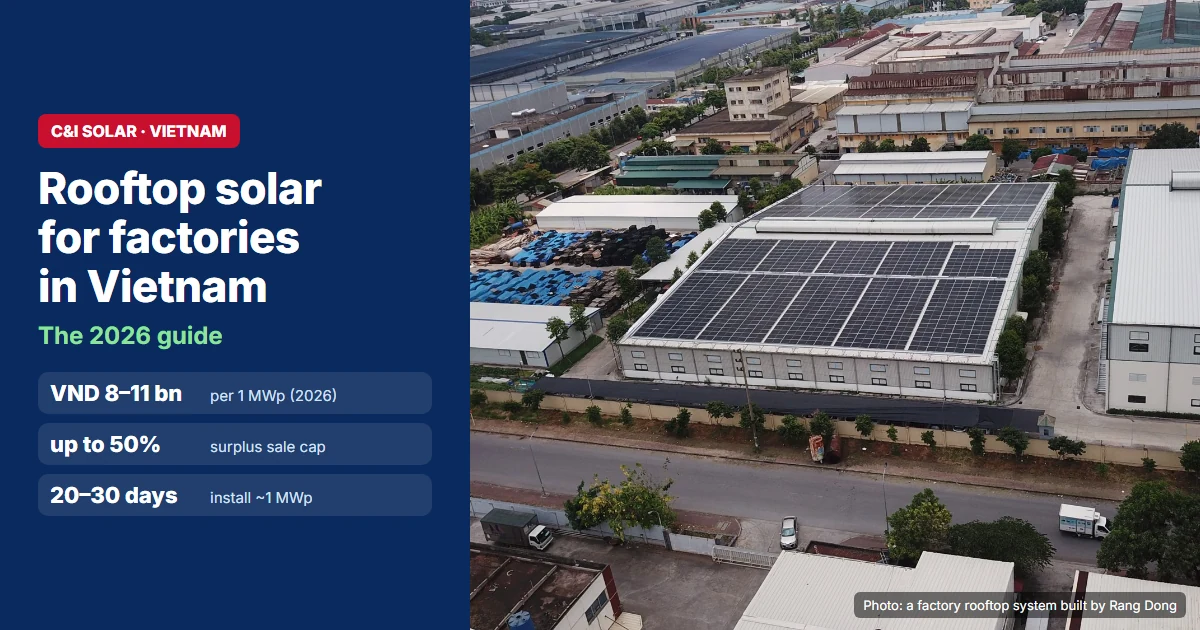
This guide to commercial and industrial (C&I) rooftop solar is written for plant managers, CFOs and regional headquarters of foreign-invested manufacturers. It covers what a rooftop solar project for a Vietnam factory costs and how much roof it needs, which business model fits, and which regulations apply. It also covers how solar supports Scope 2 targets and how a project moves from survey to commissioning. The legal summary here is short; the full detail is in our 2026 legal guide to rooftop solar (in Vietnamese).
| Production tariff (excl. VAT) | Normal hours | Off-peak | Peak |
|---|---|---|---|
| Medium voltage, above 1 kV to 35 kV (most factories) | VND 1,814/kWh | VND 1,166/kWh | VND 3,348/kWh |
| Above 35 kV to below 220 kV | VND 1,792/kWh | VND 1,123/kWh | VND 3,218/kWh |
| Low voltage, up to 1 kV | VND 1,966/kWh | VND 1,274/kWh | VND 3,586/kWh |
Source: Decision 2892/QD-BCT dated 31 October 2026, as reported by VietnamPlus (4 November 2026). Peak: 17:30–22:30, Monday to Saturday. Off-peak: 00:00–06:00. All other hours are normal hours.
1. Why factories in Vietnam are going solar in 2026
Three changes in 2025–2026 make rooftop solar easier to justify for manufacturers.
1.1. Clearer rules for selling surplus power
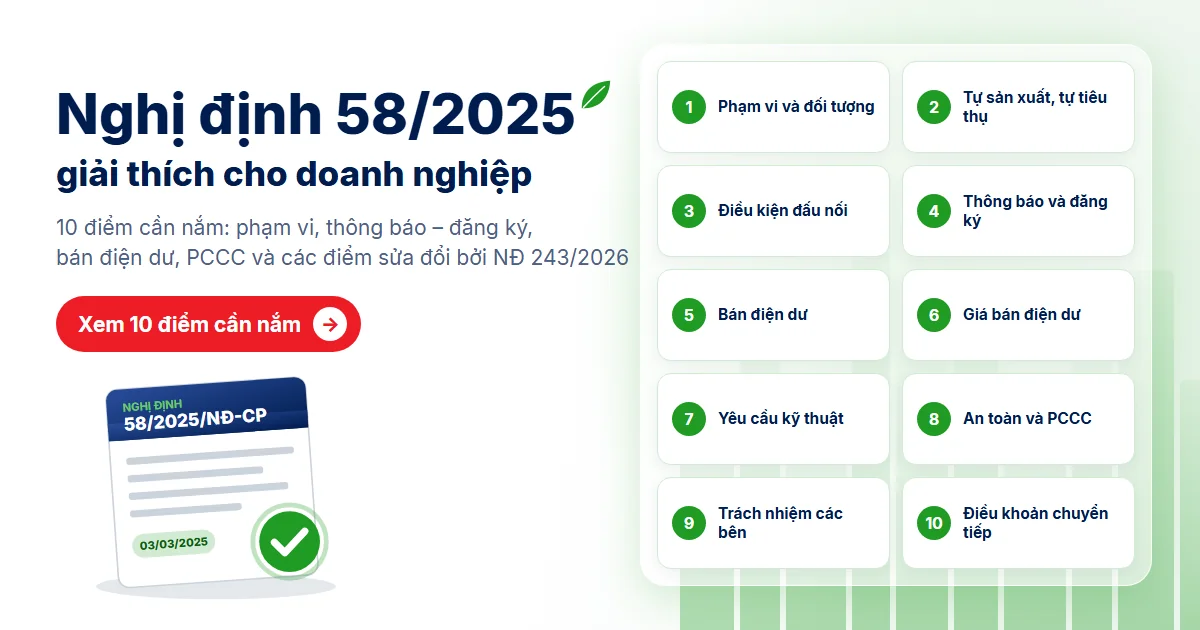
Decree 243/2026/ND-CP, issued on 26 June 2026, amends Decrees 57/2025 and 58/2025. Self-consumption rooftop systems that qualify may sell surplus electricity up to 50% of the output measured at the inverter, up from 20%. Until 31 December 2030, the parties may agree on more than 50% if the grid can absorb it.
This matters for factories that close on Sundays or run one shift. Before, much of the weekend output had no outlet. Now part of it can be sold, although the price is capped and the sale is not automatic.
1.2. A new electricity tariff and new time-of-use hours
On 1 November 2026, Decision 2892/QD-BCT replaced the previous retail tariff. The same day, new time-of-use hours under Decision 963/QD-BCT took effect for three-rate customers.
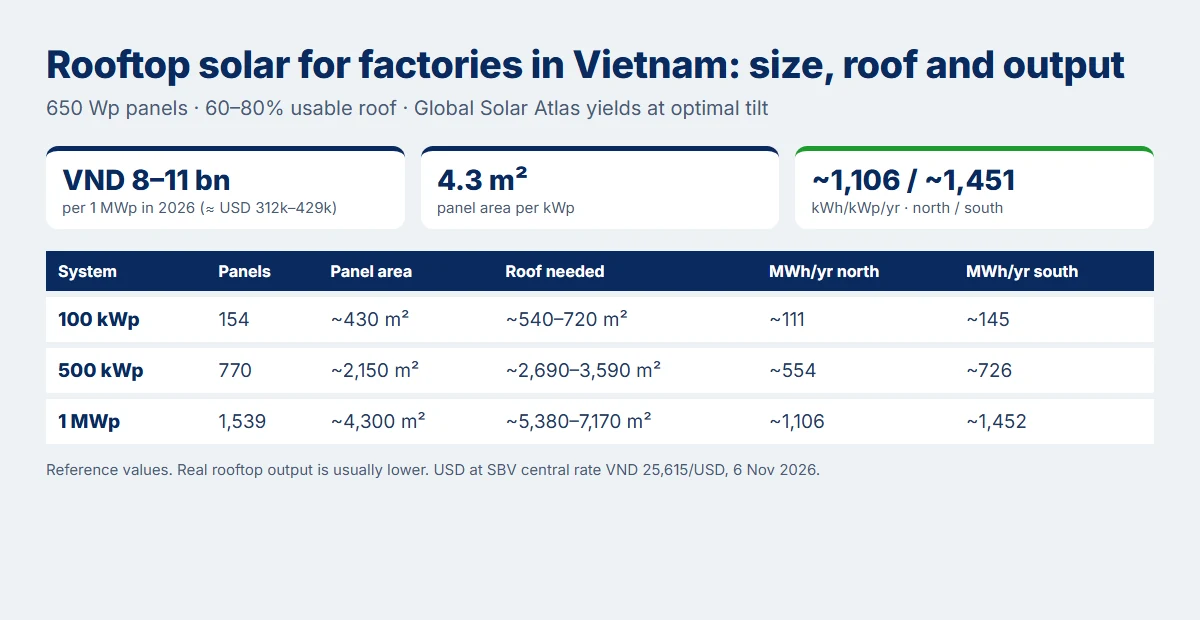
| System size | Panels (650 Wp) | Panel area | Roof area needed* | Output, north (MWh/yr) | Output, south (MWh/yr) |
|---|---|---|---|---|---|
| 100 kWp | 154 | ~430 m² | ~540–720 m² | ~111 | ~145 |
| 500 kWp | 770 | ~2,150 m² | ~2,690–3,590 m² | ~554 | ~726 |
| 1 MWp | 1,539 | ~4,300 m² | ~5,380–7,170 m² | ~1,106 | ~1,452 |
*Assuming 60–80% of the roof is usable. Output uses Global Solar Atlas yields at optimal tilt for Bac Ninh (north, ~1,106 kWh/kWp/yr) and Ho Chi Minh City (south, ~1,451 kWh/kWp/yr). Real rooftop systems usually produce less. Details: how much roof a 100 kW system needs (in Vietnamese).
Source: Decision 2892/QD-BCT dated 31 October 2026, as reported by VietnamPlus (4 November 2026). Peak: 17:30–22:30, Monday to Saturday. Off-peak: 00:00–06:00. All other hours are normal hours.
The old morning peak (9:30–11:30) no longer exists. A rooftop system therefore mostly replaces power at the normal-hour rate. Solar savings are still real, but a financial model built on the old peak hours will overstate them.
1.3. Supply-chain pressure on Scope 2
Many multinational buyers ask suppliers in Vietnam to report and reduce Scope 2 emissions from purchased electricity. On-site solar is one of the few measures a factory can control directly. It is not the only route, and it rarely covers all of a plant's demand, but it is visible to auditors and customers.
2. How much does rooftop solar cost for a factory in Vietnam?
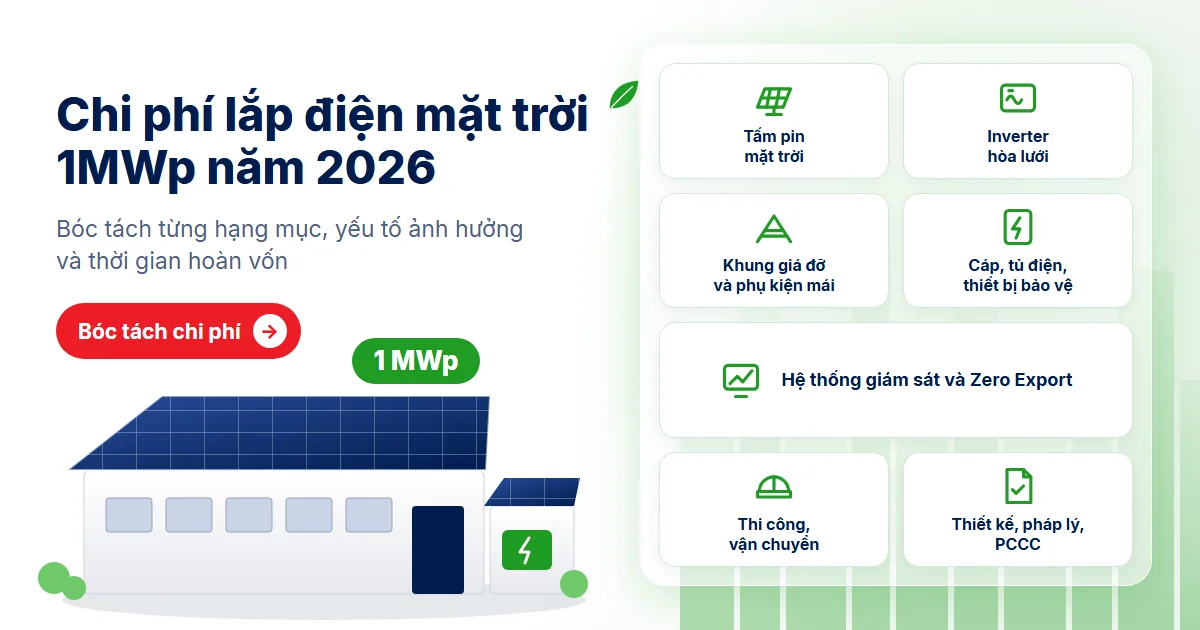
For a 1 MWp system, the total investment in 2026 is about VND 8–11 billion, or VND 8–11 million per kWp, according to our 1 MWp cost breakdown (in Vietnamese). At the State Bank of Vietnam central rate of VND 25,615/USD on 6 November 2026, that is about USD 312,000–429,000.
2.1. What drives the price
- Equipment: panel and inverter brands, and whether the design includes monitoring and Zero Export control (limiting export to the grid).
- Roof condition: old metal roofs may need structural checks or reinforcement before installation.
- Grid connection: distance to the connection point, transformer capacity and protection requirements.
- Scope: design, permits, fire safety documents and commissioning tests.
A firm quote is only possible after a site survey. Two factories with the same capacity can receive quotes that differ significantly because of roof and grid conditions.
2.2. How much roof and how much output
| Item | CAPEX (self-investment) | On-site PPA | Roof lease |
|---|---|---|---|
| Who pays for the system | The factory | A third-party investor | A third-party investor |
| Who owns it | The factory | The investor | The investor |
| What the factory gets | All savings from self-consumed power | Solar power at an agreed price | Rental income from the roof |
| Typical contract length | — | Long term, set by the contract | Long term, set by the contract |
| Main risk for the factory | Upfront capital, performance | Contract terms, price, exit clauses | Roof access, maintenance, building sale |
| Best fit | Owner-occupied plant with stable daytime load | Limited capital, long tenancy | Factory with a large roof but low daytime load |
\*Assuming 60–80% of the roof is usable. Output uses Global Solar Atlas yields at optimal tilt for Bac Ninh (north, ~1,106 kWh/kWp/yr) and Ho Chi Minh City (south, ~1,451 kWh/kWp/yr). Real rooftop systems usually produce less. Details: how much roof a 100 kW system needs (in Vietnamese).
2.3. A simple payback illustration
Simple payback = investment ÷ annual savings.
For example, assume a 1 MWp system in northern Vietnam produces about 1,000 MWh a year and the factory uses all of it during normal hours. At VND 1,814/kWh, the avoided cost is about VND 1.8 billion a year. With an investment of VND 8–11 billion, simple payback is roughly 4.4–6.1 years.
This is an illustration, not a quote or a guarantee. It ignores operations and maintenance (O&M) costs, panel degradation, financing, taxes and surplus sales, and it assumes every kWh is used on site. Your result depends on your load profile, tariff and roof.
The yield of about 1,000 kWh/kWp is close to the 997 kWh/kWp expected at the Hoa An plant in Bac Ninh. Our payback scenarios by industry (in Vietnamese) assume a higher yield of 1,350 kWh/kWp and a fixed budget of VND 10.5 billion, so their results differ.
2.4. A measured result: Hoa An plastics factory
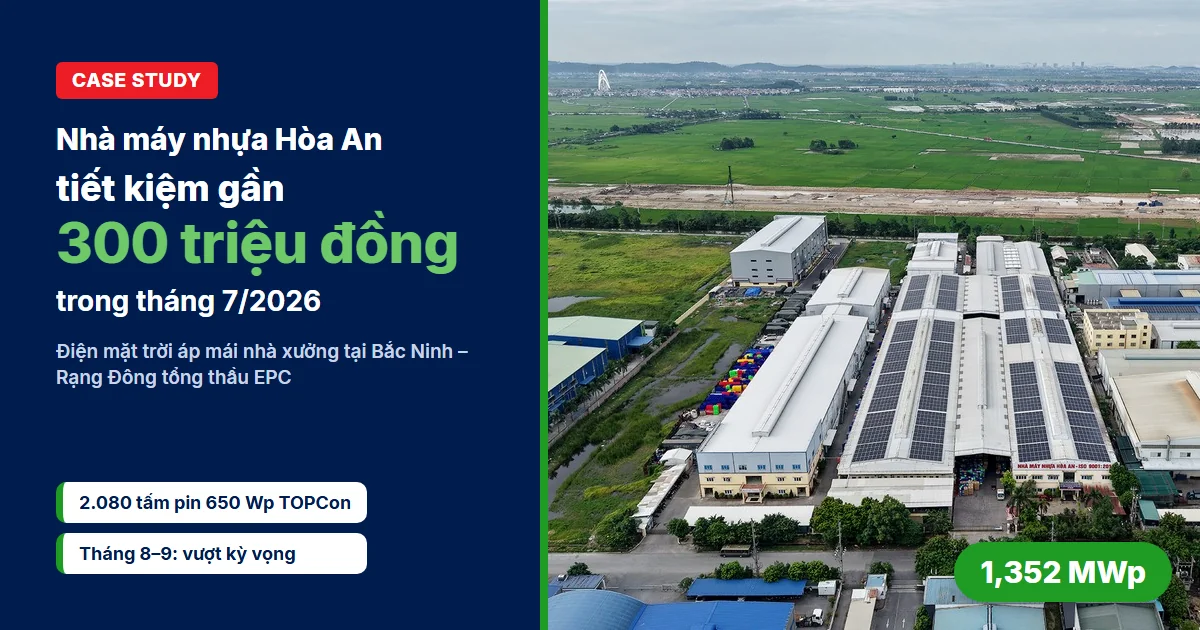
At Khai Son Industrial Park in Bac Ninh, Rang Dong was the EPC (engineering, procurement and construction) contractor for a 1.352 MWp rooftop system at Hoa An, a plastics manufacturer. The system uses 2,080 Rang Dong 650 Wp panels. In July 2026 the system produced about 123 MWh and saved the factory nearly VND 300 million (about USD 11,700) in electricity costs. The full Hoa An case study (in Vietnamese) includes the system design and monthly results.
Want a first estimate for your plant? Send your monthly electricity bills and roof area to export@rangdong.com.vn. Our engineers will reply with a preliminary system size and the data we need for a site assessment.
2.5. Is rooftop solar a good fit for your factory?
Rooftop solar for a Vietnam factory works best when several conditions line up. Use this quick check before you request quotes:
- Daytime load: the plant runs during daylight hours, ideally six days a week or more. Single-shift plants with long weekends use less of the output.
- Roof: a large, unshaded roof in good condition, with enough remaining life to match the system. Old metal roofs need a structural check first.
- Tenure: you own the building, or your lease runs long enough to cover the payback period.
- Grid connection: the transformer and switchgear can accept a solar input, or can be upgraded at reasonable cost.
If most answers are "no", solar may still work, but the business case needs closer study. It may make more sense to look at a roof lease or to wait until a roof replacement.
2.6. What to prepare before a site survey
A useful first assessment needs a few documents from the factory:
- Electricity bills for the last 6–12 months, ideally with time-of-use breakdowns
- Shift patterns and planned shutdowns
- Factory drawings, if available
- Legal documents for the company and the right to use the roof (title or lease)
You don't need all of them for a first call. Bills and roof area are enough for a preliminary system size.
3. Business models: CAPEX, PPA and roof lease
Factories in Vietnam generally choose one of three models: self-investment (CAPEX), an on-site power purchase agreement (PPA) or a roof lease. The right one depends on your capital budget, how long you will stay in the building and how much control you want over the system.
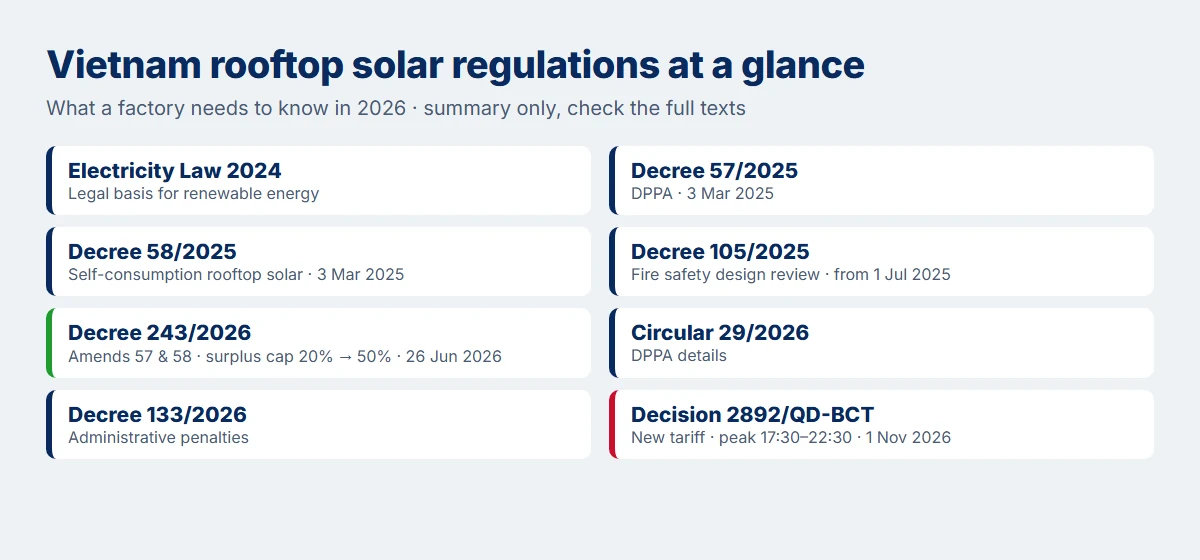
| Regulation | What it covers |
|---|---|
| Electricity Law 2024 | The legal basis for renewable energy, including rooftop solar |
| Decree 58/2025/ND-CP (3 March 2025) | Self-production, self-consumption rooftop solar: notification, registration, surplus sales |
| Decree 57/2025/ND-CP (3 March 2025) | Direct power purchase agreements (DPPA) between renewable generators and large consumers |
| Decree 243/2026/ND-CP (26 June 2026) | Amends Decrees 57 and 58: surplus cap raised to 50%, wider DPPA scope |
| Circular 29/2026/TT-BCT | DPPA details |
| Decree 133/2026/ND-CP | Administrative penalties, including for rooftop solar violations |
| Fire Prevention, Fighting and Rescue Law 2024; Decree 105/2025/ND-CP | Fire safety design review, depending on the building |
Third-party PPA structures on a factory roof need a separate legal review. They are not automatically treated as self-production and self-consumption, so check the arrangement against the current decrees before signing. Our guide to leasing a factory roof for solar (in Vietnamese) lists the contract clauses to check.
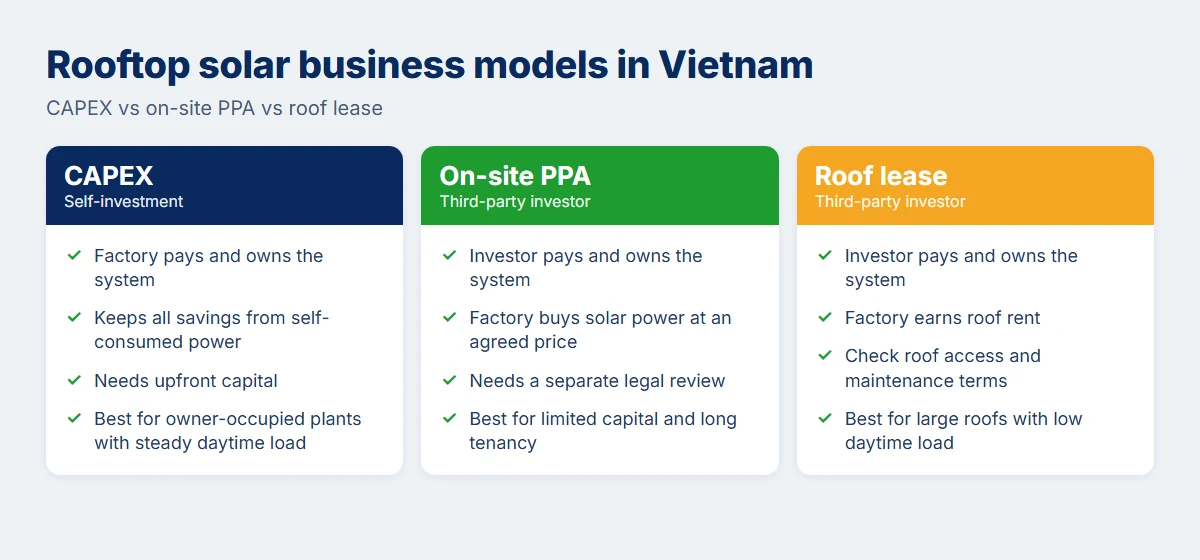
Rang Dong works as an EPC contractor, so the factory owns the system under the CAPEX model. For PPA or roof lease projects, we advise on the choice of model and on technical due diligence. We are not the investor.
4. Regulations at a glance
Vietnam's framework for rooftop solar changed significantly in 2025–2026. The table below is a summary only; read the full explanation in our rooftop solar legal guide (in Vietnamese) before you decide.
| Province (since 1 July 2025) | Formerly |
|---|---|
| Bac Ninh | Bac Ninh, Bac Giang |
| Hai Phong | Hai Phong, Hai Duong |
| Hung Yen | Hung Yen, Thai Binh |
| Phu Tho | Phu Tho, Vinh Phuc, Hoa Binh |
| Ho Chi Minh City | Ho Chi Minh City, Binh Duong, Ba Ria – Vung Tau |
| Dong Nai | Dong Nai, Binh Phuoc |
| Tay Ninh | Tay Ninh, Long An |
Source: National Assembly Resolution 202/2025/QH15 of 12 June 2025. Hanoi and Quang Ninh were not merged.
4.1. Notification or registration?
Most factory systems that do not sell surplus power only need a notification to the competent authority. A system connected to the national grid at medium voltage or above that sells surplus power typically needs a registration certificate before installation.
The exact procedure depends on inverter capacity, connection voltage and whether you sell surplus. Our guide to notification and registration (in Vietnamese) lists the forms and steps.
4.2. Selling surplus power
Under Decree 243/2026, the price for surplus sold to the power utility is capped at the previous year's average market price. It also can't exceed the regional ceiling for ground-mounted solar.
Grid capacity at your connection point also matters. A system should be sized for your own consumption first, with surplus sales as a bonus. Our Decree 243/2026 explainer (in Vietnamese) covers the conditions.
4.3. Fire safety
There is no separate fire safety procedure for every rooftop system. The obligation depends on whether the building falls under Appendix III of Decree 105/2025/ND-CP. Details are in our rooftop solar fire safety guide (in Vietnamese).
5. RE100, Scope 2 and I-RECs for multinational supply chains
On-site rooftop solar reduces the electricity a factory buys from the grid, so it lowers Scope 2 emissions. Many manufacturers use it as a first, visible step toward buyer or group targets.
How the output is counted toward RE100 or other commitments, and whether I-RECs can be issued, depends on the reporting standard and the registry rules that apply to your system. Confirm the accounting treatment with your ESG advisor or auditor before you report. Rooftop solar is one part of a decarbonization plan, alongside energy efficiency and, where available, DPPA or certificates.
6. Where we work: industrial provinces after the 2025 mergers
Rang Dong takes on C&I projects nationwide, with technical support available 24/7 after handover. Since July 2025, Vietnam has 34 provinces and centrally run cities. Many industrial zones now sit in provinces with new names.
|
Province (since 1 July 2025) |
Formerly |
|---|---|
|
Bac Ninh |
Bac Ninh, Bac Giang |
|
Hai Phong |
Hai Phong, Hai Duong |
|
Hung Yen |
Hung Yen, Thai Binh |
|
Phu Tho |
Phu Tho, Vinh Phuc, Hoa Binh |
|
Ho Chi Minh City |
Ho Chi Minh City, Binh Duong, Ba Ria – Vung Tau |
|
Dong Nai |
Dong Nai, Binh Phuoc |
|
Tay Ninh |
Tay Ninh, Long An |
Source: National Assembly Resolution 202/2025/QH15 of 12 June 2025. Hanoi and Quang Ninh were not merged.
Check the new province name on permits, grid connection documents and contracts. Notifications and registrations are filed with the authorities of the new province.
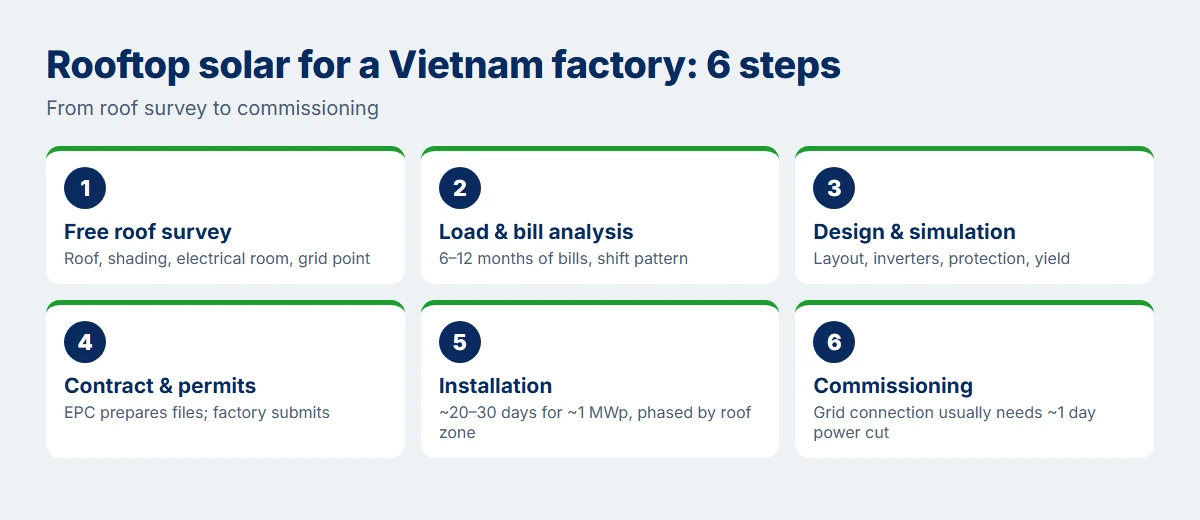
7. How to get started: a 6-step process
- Free roof survey. Engineers check the roof structure, shading, electrical room and grid connection point.
- Load and bill analysis. Six to 12 months of electricity bills and your shift pattern show how much solar the plant can use.
- Design and yield simulation. The layout, inverter sizing, protection and monitoring are designed, and annual output is simulated.
- Contract and permits. The scope, schedule and warranties are agreed. The EPC contractor prepares the notification or registration file and fire safety documents; the factory submits them.
- Installation. For a system of about 1 MWp, installation typically takes 20–30 days, depending on roof area, structure and logistics. Work is phased by roof zone to limit disruption to production.
- Connection, commissioning and handover. Connecting to the plant's electrical system usually requires a power cut of about one day, scheduled during maintenance or outside production hours.
The full project timeline, including survey, design, permits and equipment supply, is longer than installation alone. Our 8-step installation process (in Vietnamese) breaks down each stage.
8. Frequently asked questions
How much does rooftop solar cost for a factory in Vietnam?
A 1 MWp system costs about VND 8–11 billion (USD 312,000–429,000) in 2026. Smaller systems cost more per kWp. A firm price needs a site survey, because roof condition and grid connection change the scope.
Can factories sell surplus solar power to EVN?
Yes, if the system qualifies under Decree 58/2025 as amended by Decree 243/2026. The usual cap is 50% of output measured at the inverter, and the price is capped at the previous year's average market price. Grid capacity and metering conditions also apply.
Is a permit required for rooftop solar in Vietnam?
Most self-consumption systems need at least a notification. Systems connected at medium voltage or above that sell surplus power typically need a registration certificate before installation. Fire safety and construction obligations depend on the building.
Does rooftop solar help with RE100 and Scope 2 targets?
On-site solar reduces purchased grid electricity, which lowers Scope 2 emissions. How it is counted toward RE100 or certificate schemes depends on the standard you report under. Check with your ESG advisor or auditor.
How long does installation take?
For a system of about 1 MWp, installation typically takes 20–30 days. The whole project, including survey, design and permits, takes longer. The grid connection itself usually needs a power cut of about one day.
9. Work with Rang Dong on rooftop solar for your Vietnam factory
A factory rooftop solar project in Vietnam pays off when it is sized for the plant's real daytime load, the new tariff hours, the roof and the 2026 rules. Getting those four inputs right matters more than the price per kWp.
Rang Dong, founded in 1961, is a Vietnamese manufacturer of N-type TOPCon 650 Wp solar panels and an EPC contractor for C&I rooftop systems. We survey your roof free of charge and design, install and commission the system. We prepare the permit documents and guide you through submission. Our EPC rooftop solar service page (in Vietnamese) and our overview of C&I solar for businesses (in Vietnamese) give more detail.
Email export@rangdong.com.vn with your monthly electricity bills, roof area and plant location. Our engineers will reply with the next steps for a site assessment.