



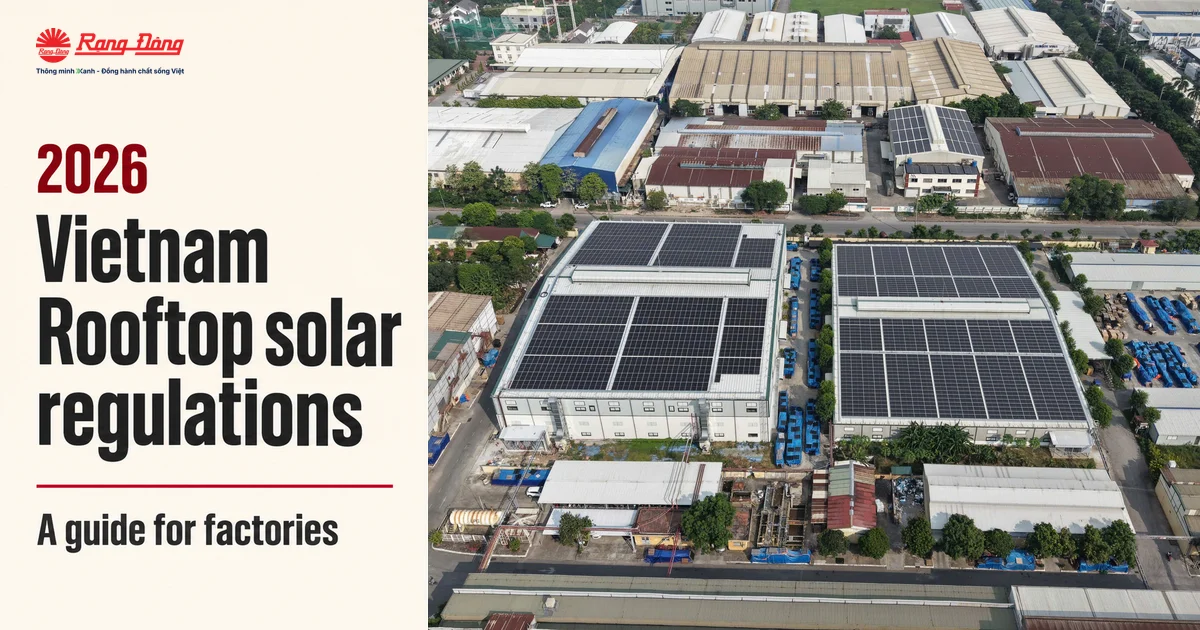
Vietnam Rooftop Solar Regulations 2026: A Guide for Factories
Cập nhật:
For a factory planning rooftop solar in Vietnam, the filing route depends on who owns the system, the grid connection voltage and whether the factory plans to sell surplus power. This guide explains the 2026 notification and registration routes and the documents to check before authorizing installation.
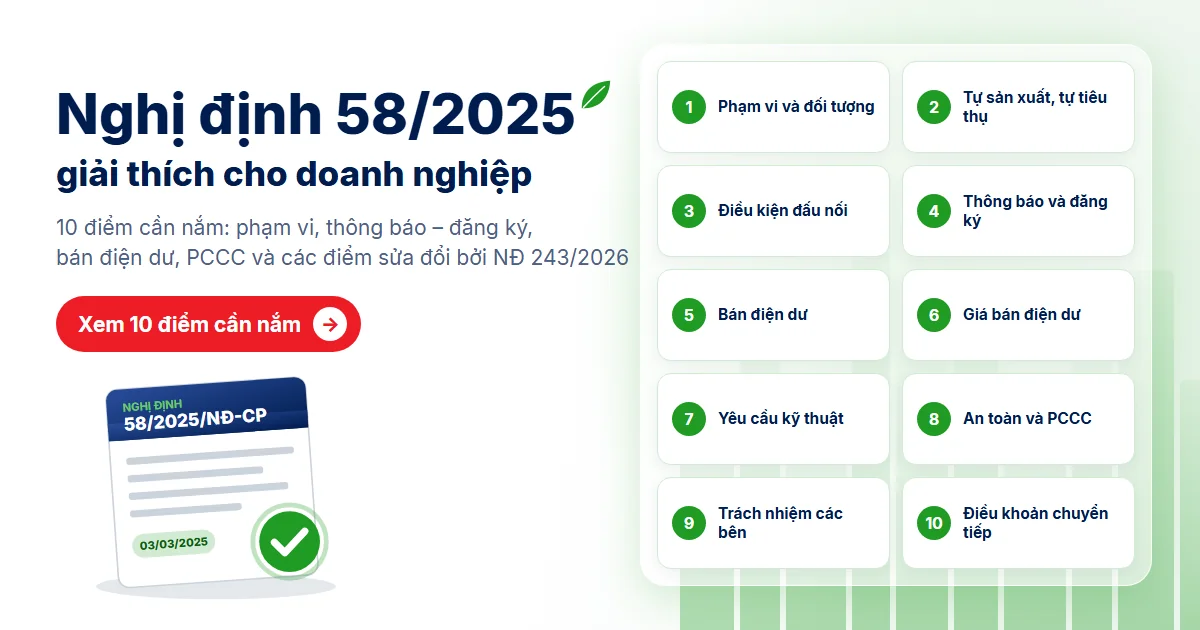
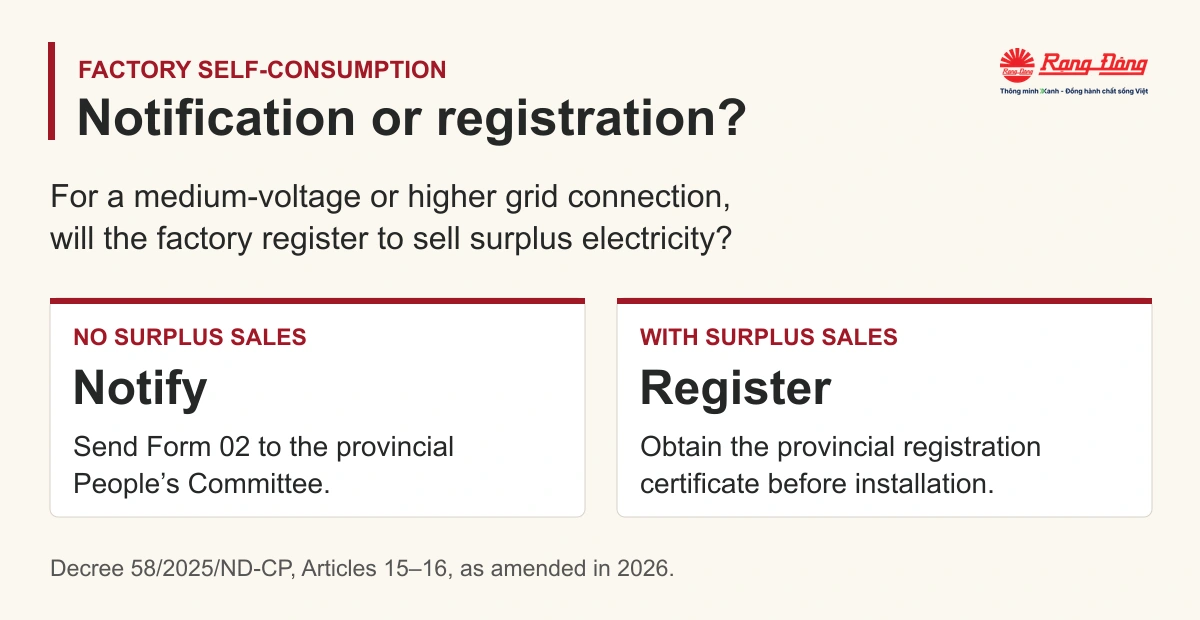
Under Vietnam’s 2026 rooftop solar regulations, a factory that generates its own electricity and connects at medium voltage or above must register before installation if it plans to sell surplus power. If it connects at the same voltage and uses the power without registering to sell any surplus, it files a notice with the provincial People’s Committee. Decree 58/2025/ND-CP, as amended by Decree 243/2026/ND-CP, sets out both routes. If another company will own the system and sell electricity to the factory, the parties also need to examine the direct power purchase framework. Government text of Decree 243
Consider a hypothetical manufacturer that leases its building and shuts its production lines on Sundays. The investment proposal shows revenue from selling weekend generation. Before approving that figure, its finance director needs three names: the company that will own the installation, the party entitled to use the roof and the buyer willing and eligible to pay for exported electricity. They may be three different entities.
What the investment team needs to know
- A medium-voltage factory generating for its own use follows different filing routes depending on whether it registers to sell surplus electricity.
- Eligible surplus sales have a 50% baseline calculated against an irradiance-based generation quantity. A higher agreed share is possible under specified conditions through 31 December 2030.
- A roof lease, a development registration certificate and a power purchase agreement each answer a different question. Identify who can supply or sign each document.
- A company that missed a filing can face both an administrative penalty and an order to complete the procedure.
Which Vietnamese decrees govern factory rooftop solar?
Start with the transaction. If the factory owns the equipment and consumes its output, examine the self-generation and self-consumption provisions. If a developer proposes to invoice the factory for each kilowatt-hour delivered, identify the seller, purchaser and delivery network before deciding which rules apply. The words “rooftop PPA” on the front of a proposal tell headquarters little about the legal route.
| Effective date | Instrument | What it changes for a factory |
|---|---|---|
| 1 February 2025 | Electricity Law 61/2024/QH15 | Establishes the legal framework for electricity development, operation, trading and use. |
| 3 March 2025 | Decrees 57 and 58/2025 | Decree 57 addresses direct power purchases. Decree 58 sets out rules for renewable energy, including self-consumption rooftop solar. |
| 25 May 2026 | Decree 133/2026 | Introduces the applicable electricity-sector administrative penalties, including specific filing offences. |
| 26 June 2026 | Decree 243/2026 | Amends both 57 and 58. Use the amended provisions when checking filing routes, surplus sales and eligible transaction structures. |
For headquarters reviewing an older feasibility study, check the date next to every legal assumption. A presentation prepared in early 2025 may accurately describe the rules when written and still give the wrong filing route or surplus limit for a new installation. For a broader investment assessment covering roof condition, daytime demand and project economics, see the factory guide to rooftop solar in Vietnam. Site teams preparing the same file in Vietnamese can use the Vietnamese overview of rooftop solar procedures. The underlying legal frameworks are available in the Electricity Law, Decree 57 and Decree 58.
Rooftop solar notification or registration: which does a factory need?
For a self-consumption project, ask the site electrical team to mark the national grid connection point and its voltage on a single-line diagram. An inverter’s output voltage, the voltage printed on a production machine and the voltage at the relevant grid connection can differ. In an industrial park, confirm the arrangement with the network operator, particularly if electricity reaches several tenants through a common substation.
| Proposed configuration | Procedure under amended Articles 15 and 16 of Decree 58 |
|---|---|
| Off-grid source of 100 kW or more | Send the specified project information to the commune-level People’s Committee where the source is installed. |
| Low-voltage grid connection | Send Form 01 to the commune-level People’s Committee. Article 15 provides a narrow exception for systems below 1 kW measured by inverter capacity. |
| Medium-voltage or higher connection, without registration to sell surplus | Send Form 02 to the provincial-level People’s Committee. |
| Medium-voltage or higher connection, with surplus sales | Apply to the provincial-level People’s Committee for a development registration certificate. Obtain the certificate before installation under the ordinary procedure. |
Other grid-connected self-consumption projects may request a development registration certificate voluntarily. For the grid-connected notification routes in Article 15(2) and (3), submit the notice at least 10 working days before installation. Keep the submission receipt and check for a response about grid capacity. If the receiving authorities give no feedback within 10 working days after the notice is sent, Article 15 allows installation in line with the notice and applicable law. If the grid operator flags a risk of overload, follow up on the authority’s response before releasing the installation order. Consolidated Decree 58, Articles 15–17 (Vietnamese)
What should procurement request before releasing the installation order?
Request the diagram used for the filing, a copy of the submitted notice or issued certificate as applicable, and any correspondence about grid constraints. Match the legal entity, site address and project details against the installation contract. When a developer proposes to add panels or change the export arrangement after approval, ask which documents and agreements need updating before authorising the change.
Keep electricity licensing as a separate item in the project file. A development registration certificate identifies an approved development under the relevant procedure. A seller of surplus electricity must also determine whether it requires an electricity operation licence or qualifies for an exemption. Record the basis for that decision alongside the proposed sale agreement. Decree 243, amendment to Article 14 of Decree 58
How does Vietnam’s 50% surplus solar power rule work?
For an eligible self-generation and self-consumption rooftop source, the parties agree the quantity of surplus electricity to be traded. The ordinary ceiling is 50% of the irradiance-based electricity quantity at the output of the rooftop source. This distinction matters when a spreadsheet simply multiplies the factory’s electricity bill, installed capacity or estimated annual output by 50%. The legal calculation refers to an energy quantity determined under the decree, with a monthly reference calculation. EVN’s explanation of the amended surplus rules
When can the agreed share exceed 50%?
Through 31 December 2030, the parties may agree a higher share where the grid at the connection point can absorb the electricity and the sale meets grid safety and power-system operating requirements. Before including the higher share in a financing case, ask for the network assessment and the buyer’s agreement. Keep any period after 2030 separate in the forecast. There is also a distinct rule for mountainous, border and island areas without national grid supply. Confirm the site meets that condition before using the provision. EVN’s guidance on the exception
How should finance model weekend exports?
Start with four quantities for the same interval: generation, electricity consumed on site, electricity delivered to the buyer’s network, and electricity accepted for payment under the applicable terms. The first two help estimate avoided purchases. The last two determine the evidence for export income. Use the applicable surplus purchase price for the paid quantity. Under the self-consumption provisions, the price refers to the previous year’s average electricity market price and is subject to the applicable ceiling. Decree 243, amendment to Article 14
For example, suppose Mai, a finance manager, sees 6,000 kWh of estimated Sunday generation and only 1,000 kWh of expected site demand for those hours. The 5,000 kWh difference identifies potential surplus before export restrictions, losses and settlement. It does not show that a buyer will pay for 5,000 kWh. In this hypothetical case, Mai asks engineering to show the export limit and metering point, and asks procurement for the proposed purchase terms. Headquarters can then compare a self-use-only forecast with a separately documented export case.
A battery introduces an additional question. The amended surplus rules can include electricity discharged from storage that the rooftop solar installation charged. If charging can also come from the grid, ask how the operator will establish the source of energy attributed to solar. Keep that metering assumption with the revenue model so the next reviewer can reproduce it. EVN’s description of eligible stored energy
When should an FDI factory consider a direct power purchase agreement?
A direct power purchase agreement, or DPPA, can be relevant when a renewable generator sells electricity to an eligible large electricity consumer. Vietnam provides two broad routes: a private connection and transactions through the national grid. Decree 57 establishes the mechanism, and Decree 243 amends its scope and commercial provisions. Identify who generates, who consumes, who owns or operates the network, and whether a licensed electricity retailer serves the industrial park. Government overview of the two DPPA routes · 2026 amendments
Private connection. Trace the electricity from the developer’s installation to the factory’s delivery point. Identify the contractual buyer and the meter that determines its invoice. If the proposal also includes surplus sales, identify the surplus buyer separately. Amended Article 6 of Decree 57 sets its own rules for rooftop generators and certain retailers in zones or clusters, including a ceiling based on actual generation for specified sales to a Power Corporation or Power Company. A sale to a qualifying zone or cluster retailer can have different terms. Identify the purchaser in the draft contract before choosing the surplus-sales formula.
National grid. This route involves the electricity market and a different set of contracts and settlement obligations. Ask the project team to demonstrate eligibility for the proposed generator, consumer and any participating retailer. Request a transaction diagram showing physical supply, who invoices whom, and which market costs or adjustments the factory would bear. A landlord’s permission to install panels covers none of those commercial questions. Decree 57 as amended by Decree 243
For a regional procurement team comparing two offers, insist on a common starting point. One bidder may quote an on-site delivery price while another forecasts savings after market settlement. Ask both to model the same factory demand profile, contract term, downtime and payment period. A credible comparison should show where a difference in savings comes from: generation, price, network charges or risk transferred to the purchaser.
What should tenants check about roof rights and fire safety?
Read the roof provisions of the lease before commissioning detailed design. Identify who controls the roof, who can permit penetrations or reinforcement, who owns the solar equipment and who can grant access during production. A tenant may control its production floor while the landlord retains the roof and arranges maintenance. Ask who can authorise structural surveys, approve the design, sign the energy contract and arrange removal when the lease ends.
The commercial issue often appears at renewal. If a solar agreement extends beyond the remaining building lease, agree what happens when the tenant leaves, the landlord sells the property or a buyer declines to take over the equipment. Record responsibility for lifting equipment, temporary removal during roof repairs, insurance and reinstatement. These are points for contract review. The documents and consents required for a particular building depend on the parties’ rights and the work proposed.
For projects using the development registration route, amended Article 17 distinguishes an existing building from new construction. Where applicable, the former requires the written approval of fire-safety acceptance results for the building, and the latter requires the fire-safety design appraisal document for the new building incorporating the source. Where the building falls outside the category requiring that appraisal, the specified dossier component is not required. Ask the building owner which category applies and which document identifies the part of the premises under review. Amended Article 17 · Decree 105/2025 on fire prevention and rescue
What happens if the factory missed a required filing?
Determine when the system was installed, which voltage applied and what the project was required to submit at the time. Under Article 7 of Decree 133, a low-voltage failure to give the required notice can initially attract a warning. Article 7(3)(a) addresses, among other cases, a medium-voltage or higher installation where a required notice was missing or work went ahead before the required registration certificate was issued. For that offence the individual fine is VND 10–20 million. Applying the decree’s organisational fine rule gives VND 20–40 million for an organisation committing the same offence. Article 7(5) also provides for corrective action. Decree 133/2026, fine rules and Article 7
If headquarters discovers a missing filing during an acquisition, obtain the installation and commissioning records, grid correspondence, filing receipts and any enforcement decision. Assign a named owner to establish which procedure applies and how to complete the remedy. The Ministry of Industry and Trade has explained that projects installed before the June 2026 amendment can still face enforcement for a missed obligation and may need to complete the applicable procedure under the decision. Keep the dates visible in the due diligence report. Ministry response on missed rooftop filings
Vietnam rooftop solar regulations: factory FAQs
Is Decree 135/2024 still the filing basis for a new project?
Decree 58/2025 ended the general effect of Decree 135/2024. For a new project, use Decree 58 as amended. For an existing installation, retain earlier documents and check the transitional provisions against the installation, filing and contract dates before deciding what must be updated. Decree 58, final and transitional provisions
Can a factory contract to sell more than half its electricity?
An eligible self-consumption project may agree a share above the ordinary 50% baseline through the end of 2030 if the grid and operational conditions are met. Identify the statutory reference quantity, site eligibility, buyer and written terms before using that share. A private-wire DPPA needs a separate assessment of the sale route.
What penalty should an investment committee allow for?
Classify the specific breach first. For example, missing a required notification at low voltage and installing a medium-voltage source before obtaining a required certificate are different offences. Include the practical cost and time to remedy the filing alongside any applicable monetary exposure.
Does a tenant need the landlord’s signature?
Check who owns or controls the roof and what the lease already authorises. When a proposal relies on a right the tenant cannot demonstrate, obtain the necessary consent or agreement before committing to installation. The party with roof rights and the party signing the electricity sale agreement can differ.
Does every factory need a new fire-safety approval for solar?
The applicable review depends on the building, the work and the relevant procedure. For a registration dossier, amended Article 17 identifies the relevant document for an existing or new building and the exception for buildings outside the appraisal category. Confirm the building classification with the project team before requesting documents.
Can a foreign-invested manufacturer participate in a DPPA?
Assess the proposed purchaser against the large-consumer and route-specific requirements. Supply arrangements in the industrial park, electricity consumption and the intended contracting parties matter. Ask the developer to identify the eligibility provision for each participant and explain how the arrangement would operate at this site.
Prepare the site file before requesting a proposal
Send the site location, electricity bills and interval demand data, the single-line diagram with the connection point marked, the remaining roof-lease term and the proposed ownership model. Include the weekend or shutdown schedule if surplus electricity is part of the investment case. Mark any document still held by the landlord or industrial park operator and identify who will request it.
For the investment paper, request two figures: savings on electricity used on site and income from eligible exports. For each, name the meter, price and contract assumption behind the estimate.
Talk to our engineers. Request a technical review through Rang Dong’s industrial rooftop solar service page (Vietnamese) to discuss the technical scope for your factory.